Artificial Intelligence (AI) has become one of the most influential technologies shaping the modern world. From chatbots and recommendation systems to self-driving technology, healthcare applications, cybersecurity, and business automation, AI is transforming how organizations operate and how people interact with technology. As the demand for skilled AI professionals continues to grow, learning artificial intelligence can open exciting career opportunities for students, graduates, IT professionals, and aspiring technology specialists.
If you are looking to build a career in this rapidly growing field, joining an Artificial Intelligence Course in Chandigarh can provide the knowledge and practical skills required to understand and work with modern AI technologies. Chandigarh has developed into an important educational and IT hub, making it a suitable location for students who want industry-focused technical training.
What is Artificial Intelligence?
Artificial Intelligence is a branch of computer science that focuses on developing machines and software capable of performing tasks that normally require human intelligence. These tasks can include understanding language, recognizing images, identifying patterns, making predictions, solving problems, and making decisions.
AI systems use algorithms, data, and computational techniques to learn from information and improve their performance. Technologies such as Machine Learning, Deep Learning, Natural Language Processing, Computer Vision, and Generative AI are important parts of the broader artificial intelligence ecosystem.
Learning these concepts through professional training can help beginners understand how intelligent applications are designed and implemented.
Why Learn Artificial Intelligence?
The increasing adoption of AI across different industries has created a strong demand for professionals who understand artificial intelligence technologies. Businesses are using AI to automate repetitive processes, analyze large amounts of data, improve customer experiences, detect fraud, and make better decisions.
A professional AI course can help learners develop technical skills that are relevant to several career paths. Students can learn programming, data handling, machine learning algorithms, model development, and AI application development.
Some major benefits of learning AI include:
- Growing demand for AI and machine learning professionals
- Opportunities across multiple industries
- Development of valuable programming and analytical skills
- Exposure to modern technologies
- Opportunities to work on real-world projects
- Potential for career growth and specialization
- Foundation for advanced fields such as Generative AI and Deep Learning
Why Choose an Artificial Intelligence Course in Chandigarh?
Chandigarh is known for its educational institutions, technology companies, training centers, and growing startup ecosystem. Students from Chandigarh, Mohali, Panchkula, and nearby regions can find various opportunities to learn technology-related skills.
An Artificial Intelligence Course in Chandigarh can offer a structured learning environment where students can gradually progress from basic programming concepts to advanced AI applications. Classroom-based practical training can also provide opportunities to interact with instructors, discuss technical challenges, and work on projects.
For students who are new to AI, instructor-led training can make complex concepts easier to understand. Professionals can also use specialized training to upgrade their existing technical skills.
What Will You Learn in an AI Course?
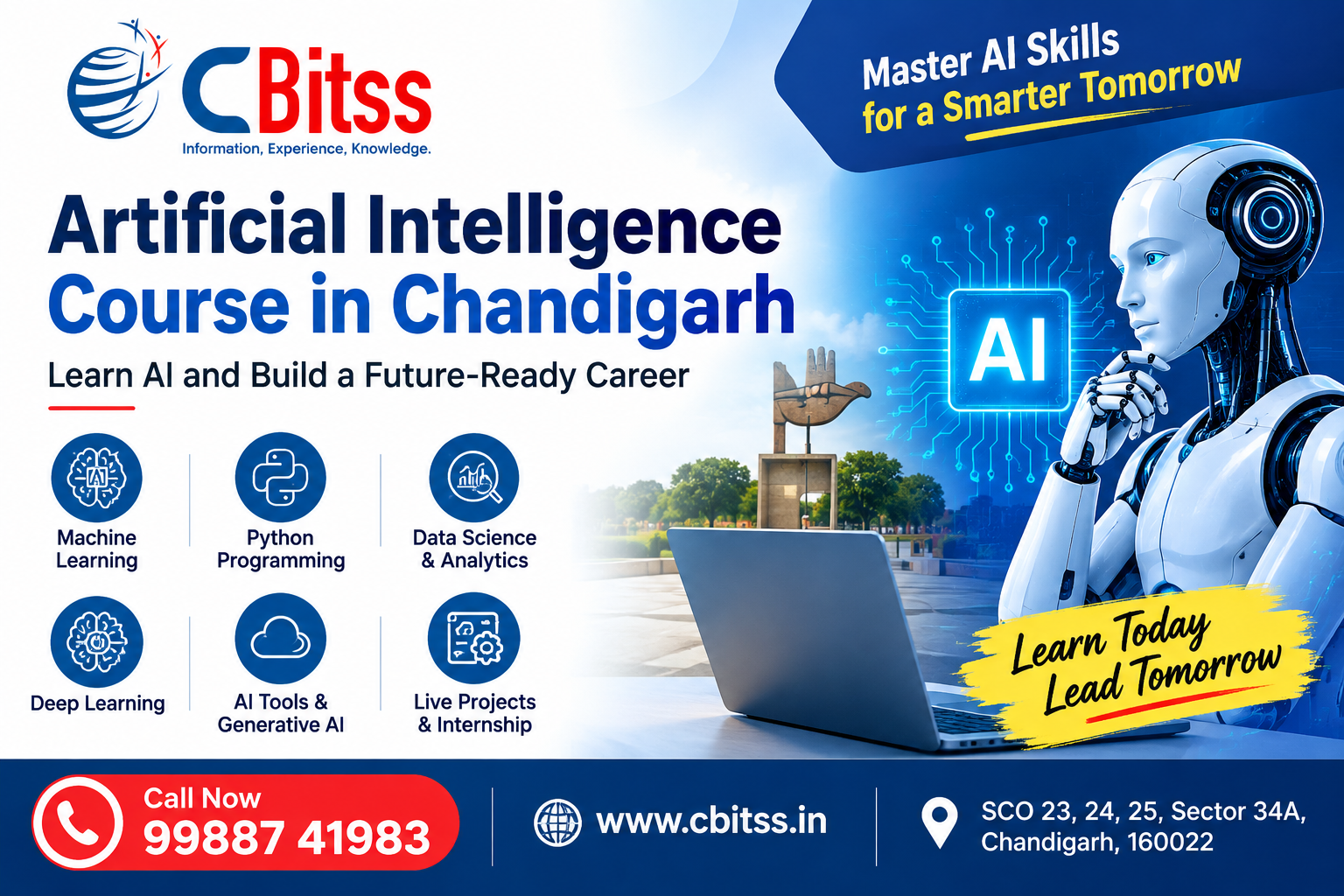
A comprehensive AI training program generally covers both fundamental and advanced concepts. The exact curriculum can vary depending on the institute and course level, but students can expect exposure to several important areas.
1. Python Programming
Python is widely used in artificial intelligence and machine learning because of its simple syntax and extensive collection of libraries. Beginners can learn Python fundamentals, functions, data structures, object-oriented programming, and commonly used packages.
Python knowledge provides a strong foundation for implementing AI algorithms and working with data.
2. Mathematics and Statistics
Mathematics plays an important role in understanding machine learning algorithms. AI training may introduce learners to concepts such as probability, statistics, linear algebra, and basic mathematical operations used in model development.
Understanding these concepts can help students better understand how algorithms process data and generate predictions.
3. Machine Learning
Machine Learning is one of the most important components of AI. It enables computer systems to learn patterns from data and make predictions or decisions without being explicitly programmed for every situation.
Students can learn supervised learning, unsupervised learning, classification, regression, clustering, model evaluation, and other fundamental machine learning techniques.
4. Deep Learning
Deep Learning uses neural networks with multiple layers to solve complex problems. It is widely used in image recognition, speech processing, natural language applications, and other advanced AI solutions.
Students can learn the fundamentals of neural networks and understand how deep learning models are trained and evaluated.
5. Natural Language Processing
Natural Language Processing, or NLP, focuses on enabling computers to understand and process human language. Applications include chatbots, voice assistants, text classification, sentiment analysis, translation, and document processing.
AI students can learn the basic concepts behind language-based applications and modern NLP techniques.
6. Computer Vision
Computer Vision allows machines to interpret and analyze visual information. It is used in areas such as facial recognition, medical imaging, security systems, quality inspection, and autonomous technologies.
Training can introduce students to image processing, object detection, image classification, and other computer vision concepts.
7. Generative AI
Generative AI has become an important area of artificial intelligence. It focuses on models that can generate new content such as text, images, audio, and code.
Understanding Generative AI can help learners explore modern applications of large language models, AI assistants, prompt engineering, and AI-powered content generation.
Practical Training and Projects
Theoretical knowledge alone may not be enough to build confidence in AI. Practical training allows learners to apply concepts to real-world problems.
A good AI training program should encourage students to work on projects involving data analysis, prediction, classification, recommendation systems, chatbots, image recognition, or other AI applications.
Project-based learning helps students understand the complete development process, including data preparation, model selection, training, testing, evaluation, and deployment.
Creating a portfolio of AI projects can also be useful when applying for internships or entry-level positions.
Career Opportunities After AI Training
Artificial Intelligence provides opportunities in several technology-related roles. Depending on their skills, education, experience, and specialization, learners can explore positions such as:
- Artificial Intelligence Engineer
- Machine Learning Engineer
- AI Developer
- Data Scientist
- Data Analyst
- Deep Learning Engineer
- NLP Engineer
- Computer Vision Engineer
- AI Research Assistant
- Generative AI Specialist
The career path can vary significantly based on individual skills and industry requirements. Continuous learning is particularly important because AI technologies and tools evolve rapidly.
Who Can Join an AI Course?
Artificial intelligence training can be useful for a wide range of learners. Students pursuing computer science, IT, mathematics, engineering, or related subjects can use AI training to develop practical skills.
Graduates who want to enter the technology industry can also consider AI courses to gain specialized knowledge. Working IT professionals may use AI training to upgrade their skills and explore new career directions.
Even beginners can start learning AI if they are willing to build their programming and mathematical foundations step by step.
How to Choose the Right AI Training Institute?
Choosing the right institute is an important decision. Before enrolling, students should evaluate several factors.
First, check whether the curriculum covers important AI technologies and programming tools. Practical training should be an important part of the course rather than focusing only on theory.
Students should also consider the experience of trainers, project opportunities, class structure, learning resources, and course duration. If possible, review student feedback and understand what type of support the institute provides during and after training.
A course that combines conceptual learning with hands-on projects can be particularly useful for learners who want job-oriented skills.
The Future of Artificial Intelligence
AI is expected to continue influencing industries such as healthcare, finance, education, manufacturing, retail, transportation, cybersecurity, and software development. Organizations are increasingly exploring intelligent automation and data-driven decision-making.
At the same time, AI professionals need to keep developing their skills. New frameworks, models, tools, and applications are introduced regularly. Learning the fundamentals provides a strong foundation, while continuous practice helps professionals stay updated.
For students in Chandigarh, starting with structured AI training can be an effective way to explore this rapidly evolving technology.
Conclusion
Artificial Intelligence is changing the technology landscape and creating new possibilities for businesses and professionals. Learning AI can help students develop valuable programming, analytical, and problem-solving abilities while introducing them to technologies such as Machine Learning, Deep Learning, NLP, Computer Vision, and Generative AI.
An Artificial Intelligence Course in Chandigarh can provide a structured path for learners who want to gain practical knowledge and explore careers in the AI industry. By selecting a comprehensive course, practicing through projects, developing a strong technical foundation, and continuously upgrading their knowledge, aspiring professionals can prepare themselves for the opportunities created by the growing adoption of artificial intelligence.
If you are interested in building a technology-focused career, now can be a good time to start learning AI and develop skills that can remain valuable as the digital economy continues to evolve.