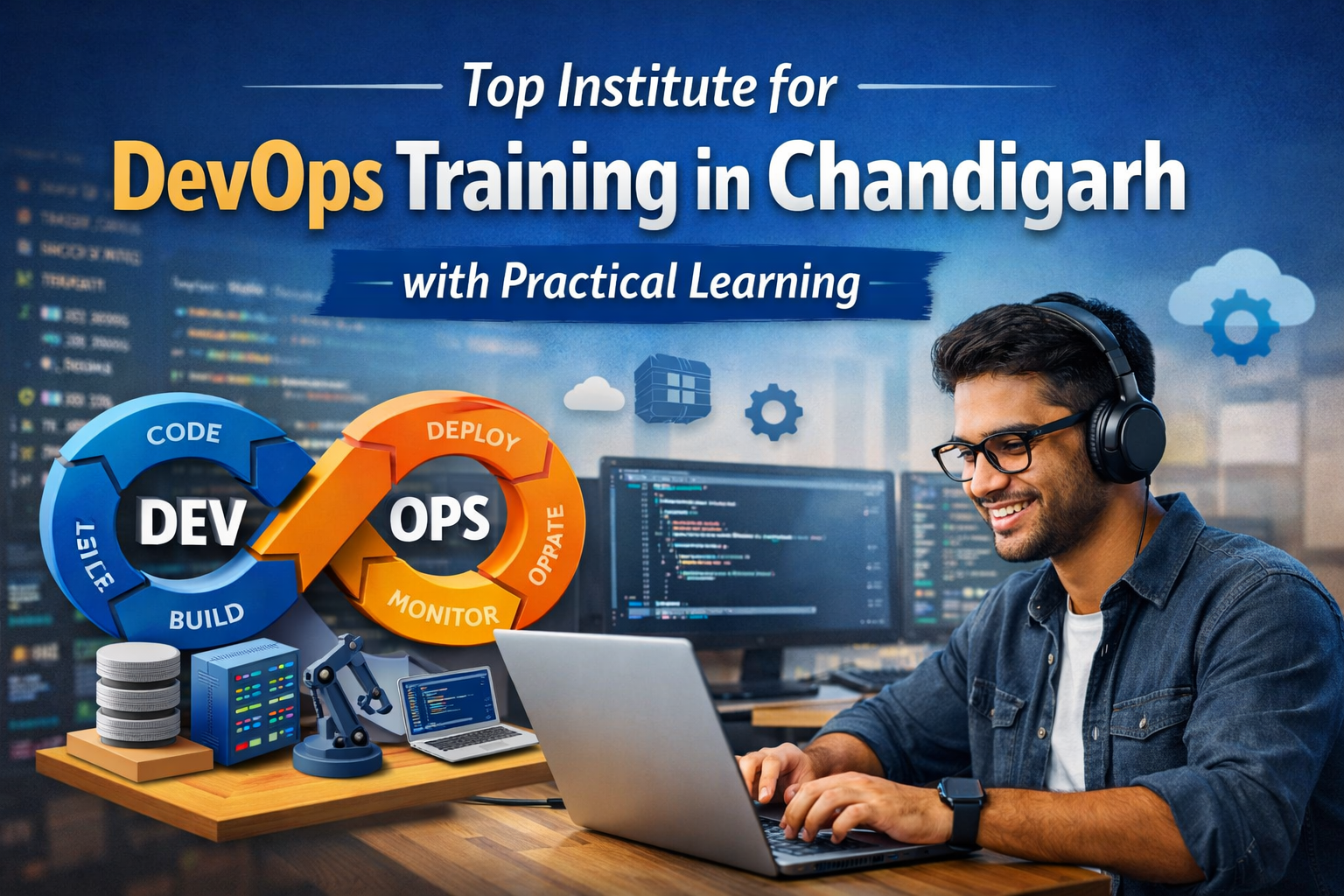
DevOps has become an important approach to modern software development and IT operations. As organisations increasingly rely on cloud platforms, automation, continuous integration, and continuous delivery, professionals with practical DevOps knowledge are needed to manage efficient software development and deployment processes.
Choosing the Best DevOps Training in Chandigarh can help students, fresh graduates, developers, system administrators, and IT professionals build skills in automation, cloud computing, containerisation, monitoring, and deployment. A practical and job-oriented DevOps course can provide learners with a structured path to understand how development and operations teams work together to deliver applications efficiently.
Instead of focusing only on theory, practical DevOps training can include tools such as Linux, Git, Docker, Kubernetes, Jenkins, AWS, CI/CD pipelines, Terraform, and cloud infrastructure. Working on projects and practical assignments can help learners understand how these technologies are used in real-world development and deployment environments.
What Is DevOps?
DevOps is a set of practices and technologies that brings software development and IT operations closer together. Its goal is to improve collaboration, automation, software delivery, reliability, and feedback throughout the application lifecycle.
Traditional development processes can involve separate development, testing, operations, and deployment activities. DevOps introduces automation and collaboration to reduce unnecessary manual work and make software delivery more consistent.
Important DevOps concepts include:
- Continuous Integration
- Continuous Delivery
- Continuous Deployment
- Infrastructure as Code
- Automation
- Version Control
- Containerisation
- Monitoring
- Collaboration
- Cloud Computing
Learning these concepts helps students understand the complete journey from writing application code to deploying and monitoring it.
Why Learn DevOps in Chandigarh?
Chandigarh and the surrounding Tricity region have a strong education and IT environment, making it a suitable location for students and professionals interested in developing technical skills.
A structured DevOps Training in Chandigarh can provide learners with a step-by-step curriculum and practical exposure to industry-used tools.
DevOps also connects several technical areas, including:
- Linux administration
- Cloud computing
- Software development
- Networking
- Cybersecurity
- System administration
- Automation
- Containerisation
Because of this broad scope, DevOps skills can complement an existing background in IT, programming, cloud computing, or networking.
DevOps Course Curriculum
A comprehensive DevOps course should begin with fundamental concepts before moving towards automation and advanced deployment practices.
DevOps Fundamentals
Students first learn what DevOps means and how it fits into the software development lifecycle.
Topics may include:
- Introduction to DevOps
- DevOps lifecycle
- Development and operations collaboration
- CI/CD concepts
- Automation
- Agile and DevOps relationship
- Continuous monitoring
- Infrastructure automation
- DevOps culture and practices
Understanding these fundamentals creates a foundation for learning individual DevOps tools.
Linux Training for DevOps
Linux is widely used for servers, cloud infrastructure, containers, and automation. Therefore, Linux administration is an important part of practical DevOps learning.
Students may learn:
- Linux commands
- File and directory management
- Users and groups
- File permissions
- Processes
- Services
- Package management
- Shell scripting
- SSH
- Log management
- Server configuration
Practical Linux skills can help learners manage servers and troubleshoot deployment environments.
Git and GitHub
Version control is an essential part of modern software development. Git allows developers and teams to track changes, manage code, and collaborate on projects.
A DevOps course may cover:
- Git fundamentals
- Repository creation
- Branches
- Commits
- Merging
- Pull requests
- Conflict resolution
- Git workflows
- GitHub repositories
- Collaboration
Students can practise managing a project repository and connecting source-code management with CI/CD tools.
Jenkins and CI/CD
Continuous Integration and Continuous Delivery are major components of DevOps.
Jenkins is commonly used to automate different stages of software development and deployment. Students can learn how to create pipelines that automatically perform tasks after developers commit code.
Topics can include:
- Jenkins installation
- Jenkins configuration
- Jobs and pipelines
- Build automation
- Source-code integration
- Automated testing concepts
- Deployment pipelines
- Pipeline troubleshooting
- CI/CD workflow
Practical pipeline projects can help learners understand how automation reduces repetitive deployment tasks.
Docker and Containerisation
Docker has become an important technology for packaging and running applications consistently across different environments.
In a practical DevOps course, students may learn:
- Docker architecture
- Docker images
- Containers
- Dockerfiles
- Docker commands
- Container networking
- Volumes
- Docker Compose
- Container registries
- Application containerisation
Students can practise creating an application image, running containers, configuring services, and managing containerised applications.
Kubernetes Training
Kubernetes is a container orchestration platform used to manage containerised workloads at scale.
A DevOps training program may introduce learners to:
- Kubernetes architecture
- Pods
- Deployments
- Services
- Namespaces
- ConfigMaps
- Secrets
- ReplicaSets
- Kubernetes networking
- Scaling
- Basic cluster management
Practical Kubernetes exercises can help learners understand how multiple containers can be deployed, managed, and scaled.
AWS and Cloud Computing
Cloud platforms are closely connected with DevOps. AWS is commonly included in DevOps learning because it provides computing, storage, networking, security, monitoring, and automation services.
Students may work with services such as:
- EC2
- S3
- IAM
- VPC
- CloudWatch
- Load Balancing
- Auto Scaling
- RDS
- AWS CLI
A practical project can involve deploying an application on an AWS server and connecting it to a CI/CD pipeline.
Other cloud platforms, such as Microsoft Azure and Google Cloud, may also be introduced depending on the training curriculum.
Infrastructure as Code with Terraform
Managing infrastructure manually can become difficult as environments grow. Infrastructure as Code allows infrastructure configurations to be defined through code.
Terraform is widely used for infrastructure automation.
Students can learn:
- Terraform fundamentals
- Providers
- Resources
- Variables
- Outputs
- State
- Terraform plans
- Infrastructure deployment
- Infrastructure updates
- Basic cloud automation
Practical Terraform exercises can demonstrate how cloud resources can be created and managed consistently.
Shell Scripting and Automation
Automation is one of the central concepts of DevOps. Shell scripting can help professionals automate repetitive Linux administration and deployment tasks.
Learners can practise scripts for:
- File management
- System monitoring
- Backups
- Application deployment
- Log processing
- Service management
- Automated administration
Combining scripting with CI/CD and cloud tools can help students understand how different components of a DevOps environment work together.
Monitoring and Logging
Deployment is only one part of DevOps. After an application is deployed, teams need to monitor its availability, performance, and resource usage.
Training may introduce:
- Application monitoring
- Server monitoring
- Log management
- Metrics
- Alerts
- Performance monitoring
- Troubleshooting
- Cloud monitoring tools
Students can learn how to identify common deployment or infrastructure problems by analysing logs and system metrics.
Practical DevOps Projects
Hands-on projects are an important part of a job-oriented DevOps course. Projects allow students to combine multiple tools instead of learning each technology separately.
Project 1: CI/CD Pipeline
Students can create a pipeline that retrieves application code from a Git repository, builds the application, performs required checks, and deploys it to a server.
Project 2: Docker Application
Learners can package a web application into a Docker image and deploy it using containers.
Project 3: Kubernetes Deployment
Students can deploy a containerised application to Kubernetes and configure services, replicas, and basic scaling.
Project 4: AWS Deployment
Learners can deploy an application on AWS using EC2, networking, security, and storage services.
Project 5: Terraform Infrastructure
Students can use Terraform to create cloud infrastructure through configuration files and manage infrastructure changes.
These projects can help learners build practical experience and create examples they can discuss during technical interviews.
Who Can Join DevOps Training?
DevOps training can be useful for people from several technical backgrounds, including:
- BCA students
- B.Tech students
- MCA students
- Computer science graduates
- Software developers
- IT professionals
- Linux administrators
- System administrators
- Network professionals
- Cloud computing learners
- Fresh graduates
- Professionals looking to upgrade their skills
Beginners can start with Linux, Git, networking, and DevOps fundamentals, while experienced professionals can move directly towards advanced automation, cloud, containers, and CI/CD.
Career Opportunities After DevOps Training
DevOps skills can support different technical career paths. Depending on experience, practical knowledge, projects, and certifications, learners may explore roles such as:
- DevOps Engineer
- Junior DevOps Engineer
- Cloud Engineer
- Cloud Operations Associate
- Build and Release Engineer
- Automation Engineer
- Site Reliability-related roles
- Infrastructure Engineer
- Platform Engineer
Career progression depends on practical ability, problem-solving skills, professional experience, communication, and continuous technical learning.
Benefits of Job-Oriented DevOps Training
A practical course can offer several learning benefits.
Hands-On Practice: Students can work with real tools rather than relying only on theoretical explanations.
Project-Based Learning: Projects help learners combine Linux, Git, Docker, cloud, CI/CD, and automation skills.
Cloud Exposure: Working with AWS or another cloud platform helps learners understand modern infrastructure.
Automation Skills: Students learn how repetitive development and deployment processes can be automated.
Interview Preparation: Practical projects provide examples that can be discussed during technical interviews.
Continuous Learning: DevOps technologies evolve quickly, so learners develop a foundation for continuing their technical education.
How to Choose DevOps Training in Chandigarh
Before selecting a DevOps institute or course, students should carefully examine the curriculum and practical training structure.
Important factors include:
- Linux fundamentals
- Git and GitHub
- Jenkins
- CI/CD
- Docker
- Kubernetes
- AWS or another cloud platform
- Terraform
- Shell scripting
- Monitoring and logging
- Practical projects
- Trainer experience
- Course duration
- Certification preparation
- Career or placement support, if offered
Students should also check whether practical sessions provide individual or guided access to tools and environments instead of only watching demonstrations.
Conclusion
DevOps combines software development, IT operations, automation, cloud computing, and continuous delivery to support modern application development and deployment. A Best DevOps Training in Chandigarh | Practical & Job-Oriented Course can provide students and IT professionals with a structured learning path covering Linux, Git, Jenkins, Docker, Kubernetes, AWS, Terraform, CI/CD, scripting, and monitoring.
The most effective way to learn DevOps is through consistent hands-on practice. By working on practical assignments and real-world-style projects, learners can understand how different DevOps tools connect and how automated deployment workflows operate.
Whether you are a student, fresher, developer, system administrator, or IT professional, building a strong foundation in DevOps can help you develop relevant technical skills for modern cloud and software environments. Combining training with projects, continuous practice, and appropriate certifications can further support your professional development in the DevOps domain.